
As a respite for daily rituals, morning routines, and late-night unwinding, there is arguably no more important a room to get the lighting right than the bathroom.
But getting it right poses unique challenges. Water, steam, and high humidity don’t just steam up mirrors, they raise serious safety concerns around electrical fittings.
So if you’re planning a modest refresh, or a full renovation, understanding the essentials of bathroom lighting will help you find the right fixtures, and avoid costly errors. Keep reading to learn more…
Understanding IP ratings
The first thing to understand with bathroom lighting is the IP rating.
So what is an IP rating? Short for Ingress Protection, an IP rating specifies how well an electrical fitting resists intrusion by solid particles and liquids. Established under British Standard BS EN 60529, it uses two digits:
- First digit (0–6): defence against solids (dust, tools, insects)
- Second digit (0–9): defence against moisture (drips, sprays, jets, immersion)
The higher each digit, the greater the level of protection. In bathrooms, the second digit is particularly important because water exposure is constant.
Let’s better understand those numbers:
| IP rating | First digit (solids) | Second digit (liquids) |
| 0 | No protection: do not use where dust or foreign objects pose a risk. | No protection; unsuitable for wet areas. |
| 1 | Guarded against large objects over 50 mm (e.g. hands): minimal defence. | Protected against vertical drips (condensation). |
| 2 | Shielded against fingers or similar objects up to 80 mm × 12 mm. | Defends when tilted up to 15° against dripping water. |
| 3 | Protected from tools or wires thicker than 2.5 mm. | Guards against water spray ≤ 60° from vertical. |
| 4 | Safe from solid objects over 1 mm, such as small screws or insects. | Splash-proof from any direction. |
| 5 | Limited dust ingress permitted: won’t hamper operation. | Can endure low-pressure water jets. |
| 6 | Dust-tight: zero ingress of particulate. | Withstands strong water jets or heavy seas. |
| 7 | – | Safe in temporary immersion up to 1 m for 30 minutes. |
| 8 | – | Designed for continuous immersion beyond 1 m. |
| 9 | – | Resistant to high-pressure, high-temperature jets or steam-cleaning. |
For most bathroom fittings, you’ll see at least a “4” or “5” as the first digit, meaning that fine dust or accidental contact can’t compromise internal wiring.
In bathroom contexts, ratings of IP44 and above are common. But you need to make sure to pair the correct rating to the precise zone where a fitting will live.
Understanding bathroom zones
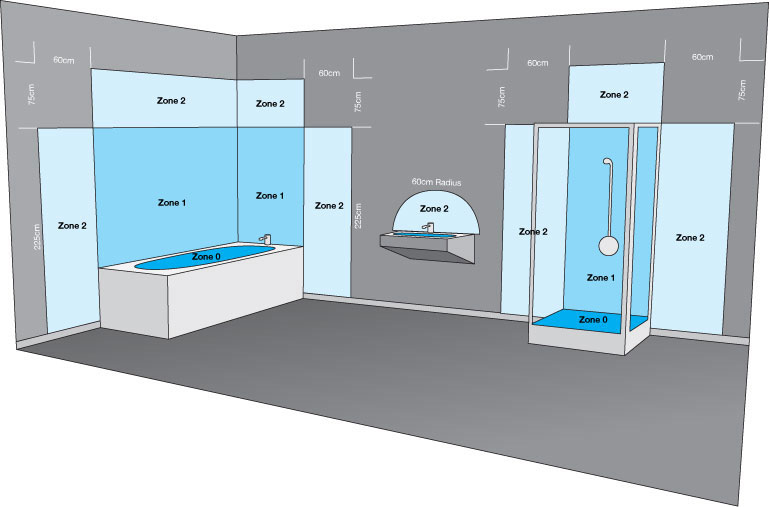
British wiring regulations (BS 7671) divide a bathroom into four distinct zones. These zones define maximum permissible IP ratings and, in some cases, voltage limits. Let’s explore each area.
Zone 0
Zone 0 occupies the interior of the bath or shower tray, where fittings may be fully submerged.
Only low-voltage lights operating at a maximum of 12 V SELV (Separated Extra-Low Voltage) are permitted here, and they must carry an IPX7 or IP67 rating to withstand temporary immersion.
In practice, this means any transformer or driver must be positioned outside Zones 0, 1 and 2 to keep vulnerable components safely clear of direct spray. Standard 240 V fixtures have no place in Zone 0, as even the slightest breach in sealing could pose a serious hazard.
Zone 1
Zone 1 sits immediately above the bath or shower tray, stretching up to 2.25 m in height. As it confronts direct spray, steam and occasional cleaning jets, fixtures here require a minimum of IPX4 or IP44 protection against splashes.
However, where power showers or jet-wash cleaning are in use, upgrading to IPX5 or IP65 is strongly advised. While 240 V fittings are allowed, they must be installed on a circuit protected by a 30 mA residual-current device (RCD). Many shower-rated lights meet IP65 as standard, ensuring reassurance under daily use.
Zone 2
Zone 2 extends 0.6 m beyond the edges of Zone 1 and covers the area around washbasin taps up to a height of 2.25 m.
Though less exposed than Zone 1, occasional splashes from basins or overflow can occur, so as a minimum, fittings should be rated IPX4 or IP44. If you routinely use water jets for cleaning here, IP65 is the smart choice. Standard mains voltage is acceptable, yet the ongoing use of RCD protection adds an extra measure of safety.
Outside Zone
Beyond these areas lies the Outside Zone (formerly Zone 3), where direct water contact is unlikely but humidity and stray splashes can still affect luminaires.
No specific IP rating is mandated by regulations, though installing at least IP20-rated fittings is sensible and IP44 is often recommended to guard against unexpected moisture ingress.
| Zone | Location | Exposure | Requirements | Guidance |
| 0 | Inside the bath or shower tray itself. | Full contact with water; submersion possible. | IPX7 or IP67—suitable for temporary immersion.
Must operate at a maximum of 12 V SELV (Separated Extra-Low Voltage). No standard 240 V units are permitted. |
Position any transformer, driver or power supply in Zone 2 or beyond to keep low-voltage components away from direct spray. |
| 1 | Directly above the bath or shower up to 2.25 m above finished floor level, and horizontally to the edge of the tray or base. | Shower sprays, steam and drips. | Minimum IPX4 or IP44—protection from splashes in all directions.
For integrated showers or power-showers, upgrade to IPX5 or IP65 to resist water jets. 240 V fittings allowed, but circuit must be RCD-protected at 30 mA. |
Most shower lights carry IP65 to ensure comfort under both dribble-head mixers and high-pressure heads. |
| 2 | The area extending 0.6 m beyond Zone 1 horizontally.
Up to 2.25 m above the floor. Draw around washbasin taps of 0.6 m radius. |
Occasional splashes from taps, basin overflows and steam from hot showers. | Minimum IPX4 or IP44—splash-proof from all angles.
If you use jet-wash cleaning in this zone, fit IP65-rated lights. |
240 V permitted without SELV constraints, though RCD protection remains wise. |
| 3 (outside zone) | All space outside Zones 0, 1 and 2. | Potential accidental splashes, steam and humidity but no direct spray. | No mandatory IP rating, though IP20 is the absolute minimum safety threshold.
Many professionals recommend IP44 to safeguard against unexpected splashes and steam. |
Standard 240 V fittings are fine; RCD recommended but not compulsory under current regulations. |
Types of bathroom lighting
Now that we have an understanding of the different bathroom zones, let’s look at the types of bathroom lighting available.
Achieving a balanced scheme involves layering three core lighting types: ambient, task, and accent, each serving a distinct purpose.
Ambient lighting
Ambient illumination provides a bathroom’s atmosphere, supplying a comfortable level of brightness that makes the room feel welcoming.
Recessed downlights
Recessed downlights are the common choice, sitting flush with the ceiling to bathe the space in even, shadow-free light without drawing attention to themselves.
A perfect option here is the Forum Cali IP65 Tiltable Downlight. Available in matt white, matt black, or satin brass, its IP65 enclosure and 7 W integrated LED module allow bright, low-energy illumination wherever moisture is present, making it ideal for Zones 1 and 2.
Semi-flush and flush-mount ceiling lights
Semi-flush and flush-mount ceiling lights add a touch of decorative flair with practical performance. By suspending slightly below the ceiling, they cast light over a wider radius and introduce a focal element in the form.
Take the Forum Lindos 3 Light Semi-Flush Ceiling Light in satin brass. Three opal-glass globes spread a warm glow around the room, while its IP44 rating makes it perfectly safe in the Outside Zone.
Pendant lights
Pendant lights add vertical drama and concentrate illumination over key areas. Their sculptural silhouettes draw the eye and create a sense of intimacy without overwhelming the space.
The Edit Basin Bathroom Ceiling Pendant Light combines sleek design with functional elegance.
Bathroom chandeliers
For those who favour a touch of the theatrical, bathroom chandeliers are a luxurious choice. Crystal-effect droplets and polished metal reflect and refract light, transforming even compact bathrooms into intimate retreats.
The Searchlight Luna 8 Arm Semi-Flush Bathroom Chandelier in smoked glass is the perfect example of this elegance. Eight LED-equipped arms beam a flattering light, and its IP44 certification ensures safe use in the bathroom’s perimeter.
Task lighting
Effective task lighting in a bathroom focuses on areas where precision matters most, primarily around the mirror and basin.
Mirror lights
Mirror lights wrap your reflection in even, shadow-free illumination so that shaving, applying makeup or inserting contact lenses becomes a straightforward ritual rather than a guessing game.
The Forum Esk 500 LED Illuminated Bathroom Mirror Light is a prime example of this. Its 500 mm integrated LED strip provides around 997 lumens through a slim polycarbonate diffuser, while its IP44 rating makes it suitable for Zone 2 installations.
Wall-mounted sconces
Wall-mounted sconces bring functionality and style to the vanity area. By positioning fittings at eye level on either side of a mirror or above, you bathe your face in flattering side light, softening features and reducing glare.
The Forum Cuco Glass Twin Wall Light achieves this effect perfectly, with two opal-glass cylinders each, and an IP44 enclosure that withstands basin splashes.
Accent lighting
When you want to add depth and character to your bathroom, accent lighting is the way to go. By highlighting architectural details, creating warm pools of light, accent lighting guides the eye around the room.
Under-cabinet and shelf strips
Under-cabinet and shelf strips are a great, unobtrusive way to introduce a gentle glow at night. Through the use of LED lighting, they are perfect for midnight trips without the jolt of overhead brightness.
Our Edit 5m 3V LED Strip Light fits beautifully beneath floating units, casting a soft uplight that doubles as a night-light.
How to craft the perfect bathroom lighting
With an understanding of IP ratings, and bathroom lighting types, it’s time to get planning your new bathroom lighting:
1. Assess your space
Begin by really getting to know your bathroom. Think about where shadows fall on a gloomy morning, or where the sun breaks through on a bright day.
If your room stretches wide, you’ll need more fittings to keep every corner bright. If your ceiling soars, think about bringing pendants or semi-flush mounts into play, so the light doesn’t feel distant.
Take note of obstacles, too. A protruding cabinet, an overhead beam or the extractor fan can force you to adjust luminaire positions to avoid awkward dark patches.
2. Layer your luminaries
Once you’ve thought about the space, it’s time to layer your lights:
- Ambient base – start with recessed downlights or a central ceiling fitting rated appropriately for its zone.
- Task focus – install mirror pairs or linear bars beside the vanity at eye height. Apply IP44 or higher if located in Zone 2.
- Accent drama – use niche LEDs, cabinet under-lighting or uplights to sculpt features. These should be the last fixtures to add, creating depth and guiding the eye.
3. Choose appropriate wattages and outputs
Talking about watts feels nostalgic. These days, we chase lumens instead.
As a rule of thumb, aim for about 150 lumens per square metre of floor space when planning your general ceiling lights. In a six-square-metre bathroom, that’s roughly 900 lumens in total.
For the mirror area, think 300–400 lumens on each side, so you’re not squinting when you shave or apply make-up. Accent features need only a gentle 100–200 lumens to highlight tiles or niches without stealing the show.
4. Embrace natural light
Don’t let your artificial lighting fight the sun.
Take note of where and when daylight streams through windows. If your bathroom basks in morning light, you might choose fittings rated nearer 4 000 K to blend in, but if you need a cosy glow come dusk, 2 700 K–3 000 K bulbs will feel more natural.
Frosted glazing and mirrored splashbacks can multiply what daylight you have, cutting back on electricity use during the day.
5. Finishing touches
Don’t let your surfaces become an afterthought. Glossy tiles and pale paints throw light back into the room, while polished marble or quartz countertops catch downward light and ricochet it sideways.
Even your brass taps or chrome fittings become little reflectors, brightening corners when paired with frosted-glass diffusers to tame glare.
Finally, give yourself control. Dimmers are an amazing for changing the mood of your bathroom. Nothing spoils a late-night soak like a blinding white flood.
Split your circuits so ambient, task and accent lights each have their own switch, allowing you to mix and match scenes at will. A simple smart panel can wake you to energising white light in the morning and wind you down with soft amber at night, all without adding more switches to the wall.
Our top choices for bathroom zone lighting
Now that we’ve covered everything you need to know about bathroom lighting, it’s time for our top recommendations. To make things easier, we’ve split this by zone:
Lights for bathroom zone 0
Deep within the bath or shower tray, fittings face full immersion and constant damp. Only low-voltage, SELV lights under 12 volts are permitted, and they must carry an IP67 rating to survive submersion.
The Adelpha Submersible Ground Light is a great choice for this area as it can be completely submersed underwater to a depth of up to 1M.
If you have a wet room, why not dot these lights across the floor as they are not only waterproof but ‘walkover’ proof too.
Lights for bathroom zone 1
Zone 1 extends directly above the bath or shower up to 2.25 metres, where spray and steam are daily companions. A minimum IP44 rating keeps moisture at bay, though an IP65 fixture gives extra confidence under power-shower jets.
If the light uses a 240V supply, a 30ma RCD (residual current device) must be used to protect the circuit in this zone.
For a contemporary vibe in your bathroom, have a look at the Mashiko Classic 360 Wall Light. This sleek fitting combines chrome and frosted glass and can be positioned either horizontally or vertically to work with your space. With an IP44 rating, it is suitable for bathroom zones 1, 2 and outside zones.
The Taif Mirror Light is a dual-purpose fitting that is also suitable for zone 1 and above. It will provide soft ambient lighting whilst you soak in the bath.
Lights for bathroom zone 2
Surrounding the bath, shower and basin by 0.6 metres and up to 2.25 metres high, Zone 2 calls for at least IP44 protection against occasional splashes.
Position the Bloc LED Wall Light on outer walls for a stylish modern bathroom or place either side of a mirror.
Alternatively, if you fancy a mirror, light and bathroom cabinet all rolled into one then the Zeus Illuminated Mirror Cabinet is a strong choice and will work well positioned above your basin.
An IP44 rated shaver light is multi-functional and a handy fitting for any bathroom – check out the Coronation Shaver Light.
Lights for outside zone
Lights for outside zoneBeyond the bath and basin buffer, splash-risk falls away but humidity lingers. Here, an IP20-rated fitting meets regulations, though IP44 adds a layer of future-proofing against steam or accidental sprays.
Recessed downlights can create an even spread of light across your bathroom and can be teamed with other light fittings for a layering effect. The fire-rated Fireguard LED6 Spotlight will bathe your room in a warm white light. For a more decorative piece of lighting take a look at the scallop shaped Cafe Semi Flush.
Find the perfect bathroom lighting at Lighting Direct
Hopefully you have found this article on bathroom lighting zones useful. If you have any questions, don’t hesitate to get in touch with our team.
Ready to transform your bathroom? At Lighting Direct, we have a wide range of bathroom lighting to help fulfil any vision.
Shop bathroom lighting today!

Maxine Clarke Senior Buyer
Maxine has been our decorative buyer since 2015. With her experience in working for consumer-led brands, she is the perfect person to pick out the latest lighting trends for both your home and business. Maxine has an eye for the best up-and-coming lighting from the UK and around the world and works tirelessly to add new brands to our portfolio. One of her trends to watch in 2020 is connectable garden lighting; with summer garden parties more and more popular, being able to build and extend your own outdoor lighting with spotlights, festoons and string lights has never been easier – simply plug and play.
Related Articles

Kitchen Island Lights: Your Complete Buying Guide
The kitchen island has become the refuge of the modern home, drawing people in for cooking, working, or simply catching up over a cup of tea. Because it sits in [...]
The Ultimate Guide to Rechargeable Lighting: Features, Benefits, and Tips
In the last decade, rechargeable lights have evolved into energy-efficient, eco-friendly, and cost-saving solutions. They consume minimal electricity, can be recharged multiple times, and provide flexibility for modern living. This [...]
Choosing festive lights for the Christmas season
As we get into November, many of us start thinking about decorating our homes for Christmas, and that means Christmas lights. Traditional fairy lights, candles, and lanterns are going to [...]